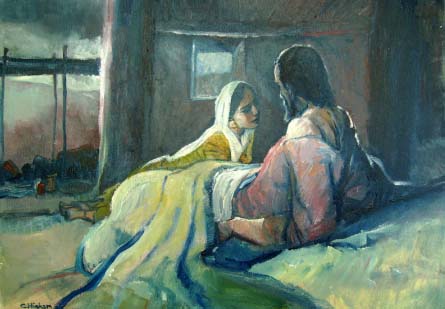
Israel requests a king
Israel has a prophet. Their king is the Lord. They, wanting to be like other nations, desire to have a king at the head of their earthly government.
1 Samuel 8: 4 Then all the elders of Israel gathered themselves together, and came to Samuel unto Ramah,
6 ¶ But the thing displeased Samuel, when they said, Give us a king to judge us. And Samuel prayed unto the Lord.
7 And the Lord said unto Samuel, Hearken unto the avoice of the people in all that they say unto thee: for they have not rejected thee, but they have brejected me, that I should not creign over them.
The Lord instructed Samuel to warn the people about what would happen with a king, but they insisted that was what they wanted.
Looking into the hearts of Saul and David (and Samuel) -- and into our own hearts.
? What positive qualities did Saul have at the time he was chosen to be king?
Looking into the hearts of Saul and David (and Samuel) -- and into our own hearts.
? What positive qualities did Saul have at the time he was chosen to be king?
Saul is Selected to be the King
His father's name was Kish. He was a Benjamite, a mighty man of power. (History of Benjamin)
1 Samuel 9:2 And he had a son, whose name was aSaul, a choice young man, and a bgoodly: and there was not among the children of Israel a goodlier person than he: from his shoulders and upward he was chigher than any of the people.
Goodly:
| Gen. 39: 6 | Joseph was a goodly person. |
| Ex. 2: 2 | a goodly child, she hid him three months. |
| 1 Sam. 9: 2 | Saul, a choice young man, and a goodly. |
| 1 Sam. 16: 12 | a beautiful countenance, and goodly to look to. |
| James 2: 2 | man with a gold ring, in goodly apparel. |
| Rev. 18: 14 | dainty and goodly are departed from thee. |
| 1 Ne. 1: 1 | Nephi, having been born of goodly parents. |
Saul is persistant in looking for his father's property (the lost asses), considerate of his father, not wanting him to begin worrying about Saul being gone so long,
? Does Saul, or does the servant suggest that they go to the Prophet? the servant
? How does Samuel know the Saul is the one to be anointed?
15 ¶ Now the aLord had btold Samuel in his ear a day before Saul came, saying,
17 And when Samuel saw Saul, the Lord said unto him, Behold the man whom I spake to thee of! this same shall reign over my people.
Samuel honors Saul and invites him to eat.
Saul is humble:
21 And Saul answered and said, Am not I a Benjamite, of the smallest of the tribes of Israel? [See Judges: All of the tribe except 600 men had been wiped out.] and my family the aleast of all the families of the tribe of Benjamin? wherefore then speakest thou bso to me?
Samuel honors Saul and invites him to eat.
Saul is humble:
21 And Saul answered and said, Am not I a Benjamite, of the smallest of the tribes of Israel? [See Judges: All of the tribe except 600 men had been wiped out.] and my family the aleast of all the families of the tribe of Benjamin? wherefore then speakest thou bso to me?
In the morning, Samuel walks with Saul and tells him to send the servant ahead. 9:27 but astand thou still a while, that I may shew thee the word of God.
Saul anoints Samuel
1 Samuel 10: 1 Then Samuel took a vial of oil, and poured it upon his head, and kissed him, and said, Is it not because the Lord hath aanointed thee to be captain over his inheritance?
? What do we know about anointings?
? What happened to Saul as he traveled home?
Samuel prophecies to Saul about what will happen as he travels on.
He will meet messengers from his father, then men who will give him food, then a company of prophets. Saul will join them and will prophecy.
6 And the Spirit of the Lord will come upon thee, and thou shalt aprophesy with them, and shalt be bturned into another man. b. Gift of the Holy Ghost -- Spiritually Reborn
Saul becomes a new man
9 ¶ And it was so, that when he had turned his back to go from Samuel, God gave him another aheart: and all those signs came to pass that day.
Saul returns home, but does not tell about his anointing.
?What happens when Saul is presented to the people?
Saul chosen in front of the people
Samuel gathers Israel. Saul hides when he is to be presented to Israel.
1 Samuel 10: 24 And Samuel said to all the people, See ye him whom the Lord hath chosen, that there is none like him among all the people? And all the people shouted, and said, God save the king.
? What happens when Saul first leads his people against enemies?
Saul fights the Ammonites
Saul anoints Samuel
1 Samuel 10: 1 Then Samuel took a vial of oil, and poured it upon his head, and kissed him, and said, Is it not because the Lord hath aanointed thee to be captain over his inheritance?
? What do we know about anointings?
? What happened to Saul as he traveled home?
Samuel prophecies to Saul about what will happen as he travels on.
He will meet messengers from his father, then men who will give him food, then a company of prophets. Saul will join them and will prophecy.
6 And the Spirit of the Lord will come upon thee, and thou shalt aprophesy with them, and shalt be bturned into another man. b. Gift of the Holy Ghost -- Spiritually Reborn
Saul becomes a new man
9 ¶ And it was so, that when he had turned his back to go from Samuel, God gave him another aheart: and all those signs came to pass that day.
Saul returns home, but does not tell about his anointing.
?What happens when Saul is presented to the people?
Saul chosen in front of the people
Samuel gathers Israel. Saul hides when he is to be presented to Israel.
1 Samuel 10: 24 And Samuel said to all the people, See ye him whom the Lord hath chosen, that there is none like him among all the people? And all the people shouted, and said, God save the king.
25 Then Samuel told the people the manner of the akingdom, and bwrote it in a cbook, and laid it up before the Lord. And Samuel sent all the people away, every man to his house.
Saul goes home, has a following, but leaves alone those who despise him.
? What happens when Saul first leads his people against enemies?
Saul fights the Ammonites
The Ammonites come up and threaten Jabesh-gilead. Word comes to Saul. He cuts up an oxen and sends it to all the tribes, inviting them to come with him to battle. They defeat the Ammonites and Saul is made king.
The people want to kill those who stood against Saul, but Saul refuses. 11:12
1 Samuel 12: 24 And Samuel said to all the people, See ye him whom the Lord hath chosen, that there is none like him among all the people? And all the people shouted, and said, God save the king.
? What event shows that Saul is turning away from following the Lord?
Good excuses? Samuel says he will come. Saul waits 7 days -- the people afraid of the Philistines, army hiding, running away1 Samuel 13:9 Saul offers the burnt offering when he did not have the authority to do so and is rejected of the Lord
25 Then Samuel told the people the manner of the akingdom, and bwrote it in a cbook, and laid it up before the Lord. And Samuel sent all the people away, every man to his house.
? What event shows that Saul is turning away from following the Lord?
Good excuses? Samuel says he will come. Saul waits 7 days -- the people afraid of the Philistines, army hiding, running away
13:12 Therefore said I, The Philistines will come down now upon me to Gilgal, and I have not made supplication unto the Lord: I aforced myself therefore, and offered a burnt offering.
13 And Samuel said to Saul, Thou hast done foolishly: thou hast not kept the commandment of the Lord thy God, which he commanded thee: for now would the Lord have established thy kingdom upon Israel for ever.
14 But now thy akingdom shall not continue: the Lord hath bsought him a cman after his own dheart, and the Lord hath commanded him to be captain over his people, because thou hast not kept that which the Lord commanded thee.
Dieter F. Uchtdorf, “A Matter of a Few Degrees,” Ensign, May 2008, 57–60
When Samuel arrived, he was brokenhearted. “Thou hast done foolishly,” he said. If only the new king had endured a little longer and not deviated from the course of the Lord, if only he had followed the revealed order of the priesthood, the Lord would have established his kingdom forever. “But now,” Samuel said, “thy kingdom shall not continue.”12
On that day, the prophet Samuel recognized a critical weakness in Saul’s character. When pressured by outside influences, Saul did not have the self-discipline to stay on course, trust the Lord and His prophet, and follow the pattern God had established.Small Errors Can Have a Large Impact on Our Lives
The difference of a few degrees, as with the Antarctica flight or Saul’s failure to hold fast to the counsel of the prophet just a little longer, may seem minor. But even small errors over time can make a dramatic difference in our lives.. . . Jeffrey R. Holland, “Amazed at the Love Jesus Offers Me,” NewEra, Dec 2008, 2–7
Saul offered sacrifice without comprehending the meaning of his sacrifice. Latter-day Saints who faithfully go to sacrament meeting but are no more merciful or patient or forgiving as a result are much the same. They go through the motions of the ordinances without an understanding of the purposes for which these ordinances were established. Those purposes are to help us be obedient and gentle in our search for forgiveness of our sins.
Saul offered sacrifice without comprehending the meaning of his sacrifice. Latter-day Saints who faithfully go to sacrament meeting but are no more merciful or patient or forgiving as a result are much the same. They go through the motions of the ordinances without an understanding of the purposes for which these ordinances were established. Those purposes are to help us be obedient and gentle in our search for forgiveness of our sins.
Saul foolishly declares that his army will fast before and during the battle. Jonathan doesn't hear about it, and is almost killed, but the people convince Saul not to kill Jonathan.
? In what ways might we be impatient with the Lord or his servants?
Is Saul given a second chance?
Is Saul given a second chance?
The Lord commands Saul (through the Prophet Samuel) to destroy Amalek and leave none alive.
15: 3 Now go and smite Amalek, and utterly adestroy all that they have, and spare them not; but slay both man and woman, infant and suckling, ox and sheep, camel and ass.
These are the people who had attacked the Israelites after they had come out of Israel -- when Aaron and Hur held up Moses' arms.
Exodus 17: 14 And the Lord said unto Moses, Write this for a memorial in a abook, and rehearse it in the ears of Joshua: for I will utterly put out the remembrance of bAmalek from under heaven.
15: 3 Now go and smite Amalek, and utterly adestroy all that they have, and spare them not; but slay both man and woman, infant and suckling, ox and sheep, camel and ass.
These are the people who had attacked the Israelites after they had come out of Israel -- when Aaron and Hur held up Moses' arms.
Exodus 17: 14 And the Lord said unto Moses, Write this for a memorial in a abook, and rehearse it in the ears of Joshua: for I will utterly put out the remembrance of bAmalek from under heaven.
1 Samuel 15: 9 But Saul and the people spared Agag, and the best of the sheep, and of the oxen, and of the fatlings, and the lambs, and all that was good, and would not utterly destroy them: but every thing that was vile and refuse, that they destroyed utterly.
13 And Samuel came to Saul: and Saul said unto him, Blessed be thou of the Lord: I have performed the commandment of the Lord.
14 And Samuel said, What meaneth then this bleating of the sheep in mine ears, and the lowing of the oxen which I hear?
15 And Saul said, They have brought them from the Amalekites: for the people spared the best of the sheep and of the oxen, to sacrifice unto the Lord thy God; and the rest we have utterly destroyed.
17 And Samuel said, When thou wast little in thine own sight, wast thou not made the head of the tribes of Israel, and the Lord aanointed thee king over Israel?
0 And Saul said unto Samuel, Yea, I have obeyed the voice of the Lord, and have gone the way which the Lord sent me, and have brought Agag the king of Amalek, and have utterly destroyed the Amalekites.
21 But the people took of the spoil, sheep and oxen, the chief of the things which should have been utterly destroyed, to sacrifice unto the Lord thy God in Gilgal. (Justifying our sins -- making excuses)
? What excuses do we make to not obey with exactness?
It’s just a little sin,” “I’m obeying the spirit of the law rather than the letter of the law,” “It won’t hurt anyone,” “I’ll try it just once,” “Other people are doing it,” or “That commandment doesn’t apply to me.”
? What excuses do we make to not obey with exactness?
It’s just a little sin,” “I’m obeying the spirit of the law rather than the letter of the law,” “It won’t hurt anyone,” “I’ll try it just once,” “Other people are doing it,” or “That commandment doesn’t apply to me.”
23 For arebellion is as the sin of witchcraft, and bstubbornness is as iniquity and idolatry. Because thou hast crejected the word of the Lord, he hath also drejected thee from being king.
24 ¶ And Saul said unto Samuel, I have asinned: for I have btransgressed the commandment of the Lord, and thy words: because I cfeared the people, and obeyed their voice.
26 And Samuel said unto Saul, I will not return with thee: for thou hast rejected the word of the Lord, and the Lord hath rejected thee from being king over Israel.
Saul hews Agag into pieces.
35 And Samuel came no more to see Saul until the day of his death: nevertheless Samuel mourned for Saul: and the Lord arepented
that he had made Saul king over Israel.
[JST. . . . rent the kingdom from Saul whom he had made king over Israel.] |
Saul as the classic tragic character -- Hubris
Richard G. Ellsworth, “The Tragic Dimensions of Saul,” Ensign, Jun 1990, 36
Richard G. Ellsworth, “The Tragic Dimensions of Saul,” Ensign, Jun 1990, 36
Saul’s tragic flaw was pride, often manifested as a fear of criticism and a love of popular approval. This flaw resulted in a tendency to make significant errors in judgment that consistently resulted in complication and misfortune. But Saul also had great strength and courage. Faced with God’s condemnation, Saul did not duck or hide but turned toward his future with violent and almost foolhardy bravery, yet without repentance, and determined to fight the Lord’s condemnation. In his attempt to force God to reverse the divine decision against him, Saul changed from one who was humble and pure, chosen of the Lord to receive great promised blessings, to one who stood angry, alone, and impenitent.
The Lord now chooses David to be king
? What qualities does David have?
? What qualities does David have?
1 Samuel 16: 7 But the Lord said unto Samuel, Look not on his countenance, or on the height of his stature; because I have refused him: for the Lord aseeth not as bman seeth; for man looketh on the outward cappearance, but the dLord looketh on the eheart.
12 And he sent, and brought him in. Now he was ruddy, and withal of a abeautiful countenance, and goodly to look to. And the Lord said, Arise, anoint him: for this is he.
13 Then Samuel took the horn of oil, and aanointed him in the midst of his brethren: and the bSpirit of the Lord came upon cDavid from that day forward. So Samuel rose up, and went to Ramah.
David plays for Saul
- Elder Marvin J. Ashton said:
- “We … tend to evaluate others on the basis of physical, outward appearance: their ‘good looks,’ their social status, their family pedigrees, their degrees, or their economic situations.
- “The Lord, however, has a different standard by which he measures a person. … He does not take a tape measure around the person’s head to determine his mental capacity, nor his chest to determine his manliness, but He measures the heart as an indicator of the person’s capacity and potential to bless others” (in Conference Report, Oct. 1988, 17; or Ensign, Nov. 1988, 15).
- Elder Marvin J. Ashton said:
- ? Why is it important that in our relationships with others, we see beyond the outward appearance and look on the heart? How can we improve our ability and commitment to do this?
David plays for Saul
14 ¶ But the aSpirit of the Lord bdeparted from Saul, and an evil spirit cfrom the Lord troubled him.
[In losing his way, he wandered among evil spirits, who enticed him to hang onto the power and the belief that he could remain king by his own skill and cunning. That is definitely a sign of insanity, when one attempts to defeat God at his own game. Satan also tried to do this, and still tries to this day to defeat God for the kingdom of Israel.-- Gerald Smith --http://joelsmonastery.blogspot.com/2010/06/gospel-doctrine-ot-22-lord-looketh-upon.html]
[In losing his way, he wandered among evil spirits, who enticed him to hang onto the power and the belief that he could remain king by his own skill and cunning. That is definitely a sign of insanity, when one attempts to defeat God at his own game. Satan also tried to do this, and still tries to this day to defeat God for the kingdom of Israel.-- Gerald Smith --http://joelsmonastery.blogspot.com/2010/06/gospel-doctrine-ot-22-lord-looketh-upon.html]
16 Let our lord now command thy servants, which are before thee, to seek out a man, who is a cunning player on an harp: and it shall come to pass, when the evil spirit afrom God is upon thee, that he shall play with his hand, and thou shalt be well.
18 Then answered one of the servants, and said, Behold, I have seen a son of Jesse the Beth-lehemite, that is cunning in playing, and a mighty valiant man, and a man of war, and aprudent in matters, and a comely person, and the Lord is with him. [Qualifications to be a leader]
19 ¶ Wherefore Saul sent messengers unto Jesse, and said, Send me David thy son, which is with the sheep.
20 And Jesse took an ass laden with bread, and a bottle of wine, and a kid, and sent them by David his son unto Saul.
21 And David came to Saul, and stood before him: and he loved him greatly; and he became his armourbearer.
22 And Saul sent to Jesse, saying, Let David, I pray thee, stand before me; for he hath found favour in my sight.
23 And it came to pass, when the aevil spirit bfrom [ JST 1 Sam. 16: 14 . . . which was not of the Lord . . .] God was upon Saul, that David took an harp, and played with his hand: so Saul was refreshed, and was well, and the evil spirit departed from him.
? What outside sources do people today sometimes turn to as they try to find relief from their sins? What is the Lord’s way for us to find relief from our sins??
Matthew 11:28–30
28 ¶ aCome unto me, all ye that blabour and are heavy laden, and I will give you crest.
? What outside sources do people today sometimes turn to as they try to find relief from their sins? What is the Lord’s way for us to find relief from our sins??
Matthew 11:28–30
28 ¶ aCome unto me, all ye that blabour and are heavy laden, and I will give you crest.
I Samuel 17 David fights Goliath
?What could the Israelites gain or lose in the fight with Goliath? verse 9 If he be able to fight with me, and to kill me, then will we be your servants: but if I prevail against him, and kill him, then shall ye be our servants, and serve us.
?How did David get the courage to fight Goliath?
37 David said moreover, The Lord that adelivered me out of the paw of the lion, and out of the paw of the bear, he will bdeliver me out of the hand of this Philistine. And Saul said unto David, Go, and the Lord be with thee.
?What could the Israelites gain or lose in the fight with Goliath? verse 9 If he be able to fight with me, and to kill me, then will we be your servants: but if I prevail against him, and kill him, then shall ye be our servants, and serve us.
?How did David get the courage to fight Goliath?
37 David said moreover, The Lord that adelivered me out of the paw of the lion, and out of the paw of the bear, he will bdeliver me out of the hand of this Philistine. And Saul said unto David, Go, and the Lord be with thee.
45 Then said David to the Philistine, Thou comest to me with a sword, and with a spear, and with a shield: but I come to thee in the aname of the Lord of hosts, the God of the armies of Israel, whom thou hast defied.
47 And all this assembly shall know that the Lord saveth not with sword and spear: for the abattle is the Lord’s, and he will give you into our hands.
____________________________________________________________
____________________________________________________________
- “There are Goliaths all around you, hulking giants with evil intent to destroy you. These are not nine-foot-tall men, but they are men and institutions that control attractive but evil things that may challenge and weaken and destroy you. Included in these are beer and other liquors and tobacco. Those who market these products would like to enslave you into their use. There are drugs of various kinds which, I am told, are relatively easy to obtain in many high schools. For those who peddle them, this is a multimillion-dollar industry, a giant web of evil. There is pornography, seductive and interesting and inviting. It has become a giant industry, producing magazines, films, and other materials designed to take your money and lead you toward activities that would destroy you.
- “The giants who are behind these efforts are formidable and skillful. They have gained vast experience in the war they are carrying on. They would like to ensnare you.
- “It is almost impossible to entirely avoid exposure to their products. You see these materials on all sides. But you need not fear if you have the slingshot of truth in your hands. You have been counseled and taught and advised. You have the stones of virtue and honor and integrity to use against these enemies who would like to conquer you. Insofar as you are concerned, you can hit them ‘between the eyes,’ to use a figurative expression. You can triumph over them by disciplining yourselves to avoid them. You can say to the whole lot of them as David said to Goliath, ‘Thou comest to me with a sword, and with a spear, and with a shield: but I come to thee in the name of the Lord of hosts, the God of the armies of Israel, whom thou hast defied.’
- “Victory will be yours. … You have His power within you to sustain you. You have the right to ministering angels about you to protect you. Do not let Goliath frighten you. Stand your ground and hold your place, and you will be triumphant” (in Conference Report, Apr. 1983, 66; or Ensign, May 1983, 46, 51).
The following quotation from Elder Spencer W. Kimball may be helpful as you discuss Saul’s disobedience with regard to the Amalekites:
“Saul rationalized. It was easy for him to obey as to the disposition of the kings, for what use were conquered kings? But why not keep the fat sheep and cattle? Was not his royal judgment superior to that of lowly Samuel? …
“How like Saul are many in Israel today. One will live some of the Lord’s revelation on health except that he must have his occasional cup of coffee; she will not use tobacco nor liquor for which she has no yearning anyway but must have the comforting cup of tea.
“He will serve in a Church position, for here is activity which he likes and honor which he craves, … but rationalization is easy as to tithepaying which he finds so difficult. He cannot afford it. … He is not sure it is always distributed as he would have it done, and who knows anyway of his failure?
“Another will attend some meetings but Saul-like rationalize as to the rest of the day. Why should he not see a ball game, a show, do his necessary yard work, or carry on business as usual?
“Another would religiously attend his outward Church duties but resist any suggestions as to family frictions in his home or family prayers when the family is so hard to assemble.
“Saul was like that. He could do the expedient things but could find alibis as to the things which countered his own desires” (in Conference Report, Oct. 1954, 51).